
The short answer? Yes — absolutely yes. Phonics can help spelling. Let’s dive in to find out how.
What is Phonics? Quick Recap!
Phonics is a method of teaching children how to read and write using the alphabetic principle.
The alphabetic principle is the understanding that there’s a predictable relationship between written letters and spoken sounds (phonemes). It means that each letter or group of letters represents a specific sound — and this relationship helps children decode (read) and, more importantly for this blog post, encode (spell) words.
Therefore as long as a child has learned the relationship between letters and the sounds they make, they can apply that knowledge to spell. So that is step one, learn which letters match to which sounds and be secure in that knowledge.
Do note: You do not need to learn the sounds of all the letters of the alphabet to start segmenting. Oh no. In a phonics programme as soon as you’ve taught a few letters, say 6-8, you should be teaching blending for reading and of course segmenting for spelling.
Spelling using phonics starts with segmenting.
Segmenting means breaking a word down into its separate sounds, one by one.
For example, if you hear the word “ship”, you can split (segment) it into the sounds /sh/, /i/, /p/. Then, as long as you know what letters represent those sounds, you can spell the word.
🔄 Note: Segmenting is the inverse of blending.
What Does Segmenting Look Like?
There are lots of ways to teach segmenting. In a synthetic phonics programme, both blending and segmenting are taught in every lesson.
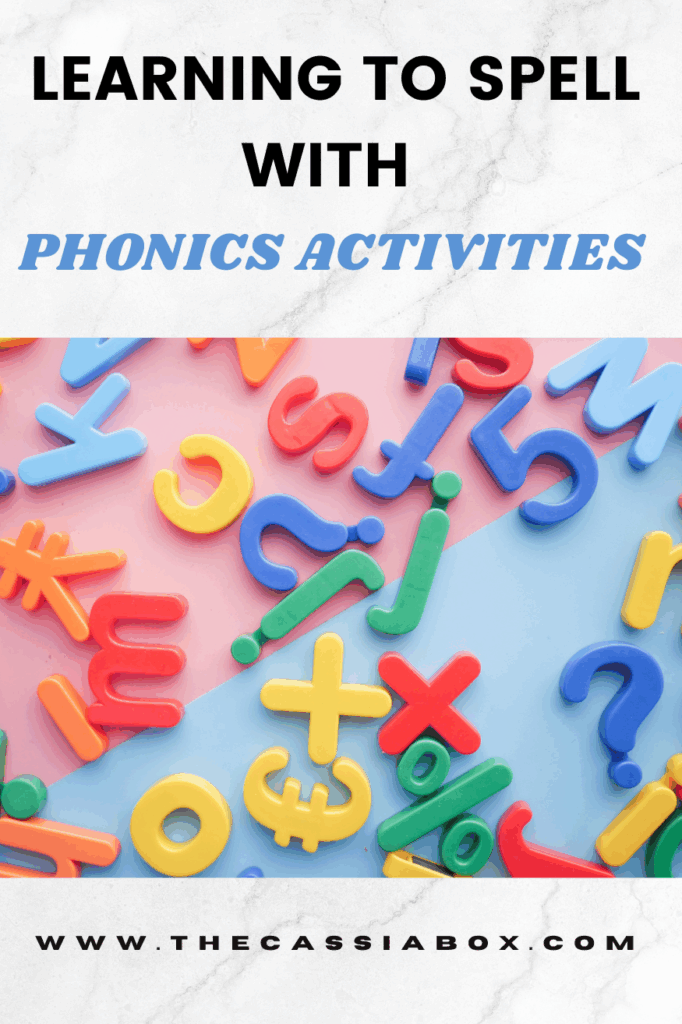
Here’s an example of a segmenting activity using magnetic letters when children are still at the early stages of learning.
Spelling with Magnetic Letters
✨ What You Need:
- Magnetic letters (10–12 familiar sounds)
- A phoneme frame (with 3 boxes)
- A whiteboard or surface to work on
📝 What To Do:
- ADULT MODELLING: Say a CVC word (e.g. sun), and then repeat it slowly, stretching out the sounds.
- Say it in sound-talk: /s/ /u/ /n/ — touching a finger for each sound, or use robot arms (using phoneme fingers or robot arms makes segmenting multisensory).
- Demonstrate finding the magnetic letters: place ‘s’ in the first box, ‘u’ in the second, and ‘n’ in the third. Say the sound as you move the letter into place.
- Say the sounds again, then blend: /s/ /u/ /n/ → sun.
- CHILDREN TAKE PART: Say a new word (e.g. mat) and ask or gesture by pointing to have the children repeat it. Try to encourage your learners to respond to simple gestures or commands to minimise talk.
- Guide them to segment the word using phoneme fingers or robot arms: /m/ /a/ /t/. Again it would great to encourage your learners to respond to simple gestures or commands for segmenting. You could say ‘phoneme fingers’ and they know they should sound-talk the word as they touch each finger.
- Ask what letter goes in the first box, then the second and third, letting children find the letters.
- Blend to read: /m/ /a/ /t/ → mat. Check the letters are in the correct order.
Spelling with Phoneme Fans
✳️ Want phoneme frames for this activity? Grab a set [here].
✳️ No magnetic letters? You can use my printable ones, or buy a set of magnetic letters online here (UK) or here(US).
Use the same strategy as discussed above, when spelling with phoneme fans.
Children choose the correct letters from their fan (containing no more than 10–12 known graphemes) and line them up in the right order to spell the word.
👉 Grab my printable alphabet fans [here].
Like free stuff? Yes Please👇
FREE PASTEL CALENDAR KIT
Packed with soo many resources – monthly calendar, pocket calendar, special events cards AND more!

Spelling Words – Writing on a Whiteboard or Phoneme Frame
You can progress to having children write the sounds, either on whiteboards or in phoneme frames.
✨ What You Need:
- A whiteboard pen and rubber
- A phoneme frame (if using this)
- A whiteboard or surface to write on (if using a whiteboard)
What To Do:
- ADULT MODELLING: Say a word (e.g. ship),
- Say ‘phoneme fingers’ and adult will sound-talk it: /sh/ /i/ /p/.
- Model touching each finger for each phoneme. Explain that sh is one sound, even though it’s made of two letters. Refer to a sound mat or display.
- Write the letters in a phoneme frame, one sound per box. Refer to a sound mat or classroom display as needed. Note: sh is in one box.
- Say the sounds again, then blend to check: /sh/ /i/ /p/ → ship.
- CHILDREN TAKE PART: Say a new word (e.g chip) and ask the children to repeat it.
- Say ‘phoneme fingers’ and the children will sound-talk it, touching each finger as they say each sound.
- Children will write the word, one sound in each box.
- Encourage them to check carefully that they recorded all the sounds in the correct order. 3 fingers means 3 sounds should be recorded. Use a sound mat only if needed. Try to encourage your learners to remember how to write each phoneme.
- Say the sounds again, teacher records so the class can see, blend to check as a class: /ch/ /i/ /p/ → chip.
Daily Spelling Practice Ideas
Once children can segment, encourage them to use this skill regularly:
- Writing labels for anything but start with CVC objects
- Making simple lists
- Writing short captions
- Playing Quickwrite games (timed word writing)
Benefits of Phonics Instruction for Spelling
I hope this blog post was helpful. Here is a reminder of the benefits of phonics instruction for spelling. Here’s what you’ll gain:
- Improved Spelling Accuracy: Learners can spell unfamiliar words using known patterns.
- Enhanced Reading Skills: Phonics strengthens both reading and spelling in tandem.
- Increased Confidence: Children feel proud when they can spell independently! What a win!!
📚 Want More Phonics Help?
Do check out some of the other articles all about phonics and don’t forget to get the FREEBIE resources I mentioned in this post.
- 🔟 10 Common Phonics Mistakes and how to avoid them – a must read! Don’t make these mistakes.
- 🧠 Dive into phonics lingo decoded in my post Crack the Code: Understanding Phonics Terms Easily
- 🔤 Need alphabet tools? Grab my printable alphabet flashcards [here]
Found this helpful? Do check out my article about the 10 mistakes you should NEVER make when teaching phonics – and how to avoid them.
Life’s Better Together! Sign Up & Stay In the Loop.
Thank you!
You have successfully joined our subscriber list.
Check Out My Resouces...
Thanks for stopping by. Looking for some classroom printables? Check out these posts:
- ☀️ Seasons and months posters – Support your learns to learn the seasons and which months they are in.
😊 Welcome Signs Pack – Get a set of gorgeous welcoming signs to brighten your room.


