

This post about why it’s important to close the Word Gap.
As an early years teacher, I’ve seen firsthand how children walk through the classroom door on their very first day of school with very different levels of vocabulary and confidence. One particular pupil I could think would always be ready to dive into stories, chat with friends, and explore new ideas. Other pupils were quieter, struggling to find the right words, or not yet used to having long conversations with an adult.
For so many of my pupils, this difference isn’t about intelligence or potential. It’s about exposure. Some children have had years of listening to stories, talking with adults, and learning new words in different contexts. Others, for many reasons, simply haven’t had as much of that experience.
That’s what educators call the “word gap” — and it can be huge. Research has shown that by the age of four, children from word-rich environments may have heard millions more words than those who haven’t. Do check out Hart and Risely’s landmark study of the disparity when comparing children from disadvantaged backgrounds with those who aren’t. And those early years matter. A strong vocabulary gives children a head start with reading, writing, problem-solving and even making friends.
The good news? Parents have enormous power to close this gap. And the most effective tool is also the most joyful: reading together!
Reading: More Than Just Words on a Page
Often when I converse with parents, they think of reading as simply decoding words — helping children recognise letters and sounds. Of course a child starting school focuses on learning the mechanics of reading but reading is so much more than that. In this blog article we’ll focus not on the use of phonics as a vehicle to learn to read but the broader aspects of reading. Reading as a means of connecting, developing understanding, critical thinking and so much more.
When you sit with your child and share a story, you’re:
- Expanding vocabulary – Children hear words they won’t hear in everyday conversations.
- Building comprehension – They begin to understand how stories work, how events connect, and why characters make choices.
- Strengthening empathy – By stepping into a character’s shoes, they learn to recognise and talk about feelings.
- Developing critical thinking – With the right prompts, they don’t just listen to a story; they question, analyse, and predict.
So yes, reading is powerful. But here’s the secret: the real gold is in the conversations you have with your child while (and after) reading. So remember sharing books is important but also having those conversations play a part in closing the word gap!
The Parent Struggle: “I Want to Help… But What Do I Ask?”
Parents know that spending time reading with their child is important but often want guidance because they are unsure of how to approach it all.
It’s such a common worry. Most of us weren’t trained to guide children through stories in a way that deepens learning — and let’s face it, at the end of a long day, it’s easy to just read the words on the page and call it done.
That’s exactly why I created Book Companions — to give parents the confidence and tools to turn everyday story time into brain-building, empathy-growing, school-ready learning.
What Book Companions Offer Parents
Think of a Book Companion as your personal story time coach sitting beside you. Each one includes:
- ✅ Bloom’s Taxonomy-based questions – These start with simple recall (e.g., “What happened first?”) and gradually move to deeper thinking (e.g., “Why do you think the character made that choice?”). This helps children not just remember, but think critically and creatively.
- ✅ Empathy-building prompts – Questions that encourage your child to notice emotions in stories and connect them to their own experiences (e.g., “How do you think she felt when that happened? Have you ever felt that way?”).
- ✅ Clear, parent-friendly guidance – No educational jargon, no overwhelm. Just simple ways to bring conversations to life, even if you’ve never done this before.
The goal isn’t to turn story time into a lesson. I really want to emphasise that, there is a time and place for everything and story time shouldn’t turn into formal lesson time. It’s to make the experience for your little one richer, more interactive and more meaningful.
What it looks like
Let’s imagine you’re reading a picture book about a character who feels left out of a game. Normally, you might read the story, close the book, ask your child what their favourite part was, and simply move on.
But with a Book Companion, story time becomes so much richer. Its guidance is always at your fingertips — no scrambling for ideas or late-night Googling required.
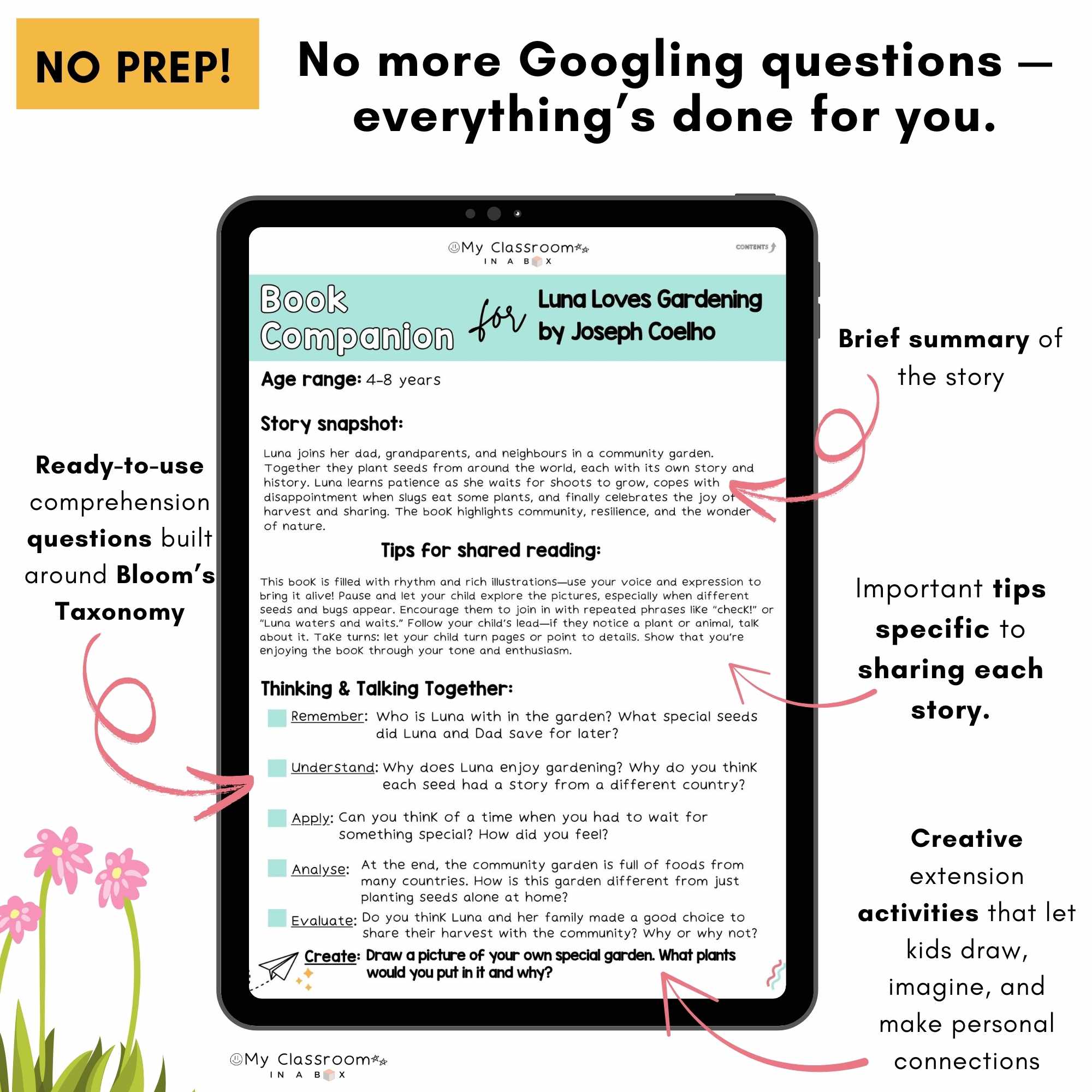
Get a free sample book companion for the book Luna loves gardening by Joe Coehlo to follow with this article.
Inside, you’ll find ready-to-use comprehension questions built around Bloom’s Taxonomy, emotional growth prompts that support empathy and kindness, and creative extension activities that let children draw, imagine, and make personal connections. Plus, with simple parent guidance included, you’ll feel confident leading meaningful conversations anywhere — whether you’re snuggled up at bedtime or chatting in the car.
At the start of each guide, you’ll find a synopsis of the text and the age it’s geared towards. There are reading tips specific to each book so you know the tone of voice to use and how best to read it to promote connection and understanding. You’ll also see prompts for where to pause, encouraging your child to join in with repeated phrases and engage more deeply with the story.
So instead of stopping at “What was your favourite part?” at the end, your conversation can begin while reading or afterwards, and might sound like this:
- “Can you tell me what happened when the character was left out?”(recall)
- “Why do you think the other children didn’t include them?”(analysis)
- “How do you think the character felt?”(empathy)
- “What would you do if you saw someone being left out at school?”(real-life connection)
See the difference? Suddenly, your child isn’t just listening to a story. They’re practicing vocabulary, problem-solving, and emotional awareness — all wrapped up in a cosy bedtime moment.
And the learning doesn’t have to stop there. Each guide also suggests follow-up creative activities — think drawing, crafting, meal planning, or even planting — plus a list of specific vocabulary to explore together to build language skills. You can dip in and out depending on your child’s age, mood, and interest, and since favourite books are often read again and again, your Book Companion guide is always there with a wealth of activities and questions to make story time more impactful.
8 BOOK - Growing & Nature Story Set
Grab this NO PREP resource with tips for shared reading, comprehension and SEL focused questions and creative activities! Growing and Gardening Bundle.
Why Closing the Word Gap Matters for School Readiness
When children arrive at school with strong communication and language skills, it sets them up for success in every area:
- Academically – They understand instructions, join discussions, and tackle reading with confidence.
- Socially – They can express their needs, make friends more easily, and resolve conflicts.
- Emotionally – They’re better at recognising and talking about feelings, which supports resilience.
Closing the word gap doesn’t just mean “knowing more words.” It means giving your child the tools to thrive.
Every Parent Can Be Their Child’s First Teacher
Here’s the part I want every parent to hear: you don’t need to be a teacher to make a real difference. You don’t need fancy flashcards or expensive programs.
All you need is a book, a child, and the willingness to talk, listen, and wonder together.
And if you’d like a little guidance along the way, that’s exactly what my Book Companions are here for — to make story time easy, meaningful and confidence-boosting for you and your child.
Because when we close the word gap together, we’re not just preparing children for school. We’re opening doors for their future.
📚Ready to see how powerful story time can be? Explore my Book Companions Set today and turn every bedtime story into a chance to grow language, empathy, and confidence.
Life’s Better Together! Sign Up & Stay In the Loop.
Thank you!
You have successfully joined our subscriber list.
Check Out My Other Resources...
Thanks for stopping by. Looking for some classroom printables? Check out these posts:
- ☀️ Seasons and months posters – Support your learns to learn the seasons and which months they are in.
😊 Welcome Signs Pack – Get a set of gorgeous welcoming signs to brighten your room.
