

Phonics is a proven and powerful method for teaching reading, used successfully in schools across the UK, Australia, and beyond. But what is phonics exactly—and why is it so effective?
In this post, we’ll explore what is phonics and how it works, the different types of phonics approaches (and which is best) and how it compares to other reading methods.
📌 If you’re new to phonics, you might also like to read Crack the Code: Understanding Phonics Terms for a helpful glossary of key terms with examples.
What is Phonics?
Put simply, phonics is a method for teaching reading by developing children’s understanding of the relationship between written letters (or groups of letters) and the sounds they make. This sound-letter knowledge forms the foundation of successful early reading and spelling.
4 Main Types of Phonics Approaches
There isn’t just one way to teach phonics. Here are the four main approaches:
- Synthetic Phonics– Teaches children to convert letters into sounds (phonemes) and then blend them to read words. This is the most widely recommended method (used in the UK and Australia).
- Analytic Phonics– Focuses on whole words first, then teaches children to analyse letter-sound relationships within those words.
- Analogy Phonics– Uses known word parts (like rimes or word families) to help decode unfamiliar words (e.g., knowing -at helps with cat, bat, hat).
- Embedded Phonics– Teaches phonics skills in the context of authentic reading and writing, rather than through structured lessons.
Of the four main types listed, synthetic phonics is considered the most effective and systematic approach for early reading, a conclusion strongly supported by numerous research studies and the landmark findings of the Rose Review (Rose, 2006), which emphasised the importance of systematic, high-quality phonics teaching as the prime approach to teaching early reading skills.
This quote from The Reading Framework, Department for Education, 2021 states, ‘The Education Endowment Foundation (EEF) is the government-designated What Works
Centre for Education, providing authoritative advice on evidence to improve teaching and
learning. The EEF considers synthetic phonics to be one of the most secure and best-
evidenced areas of pedagogy and recommends all schools use a systematic approach to
teaching it.”
Now this quote from Ofsted’s English Research Review, published in 2022 is a significant. It states, “A rigorous review and meta-analysis of research literature on reading by the National Reading Panel (NRP), from the United States, found it highly beneficial for phonics teaching to begin on entry to school. According to the NRP analysis, systematic phonics teaching is much more effective if introduced early on rather than after American first grade at age 6. Daily systematic phonics instruction leads to a faster start in early reading and spelling. Findings from cognitive neuroscience reinforce the importance of early phonics teaching. This allows children to develop efficient word-reading skills. Children become primed to learn to read.” Find the article referenced here. So let’s dig deeper into synthetic phonics and why it’s so effective.
➡️ Want to make sure you’re using the best methods to teach your learners? Learn more about common pitfalls in 10 Mistakes Made When Teaching Phonics—and How to Avoid Them.
How Does Synthetic Phonics Work?
In a synthetic phonics approach:
- Simple and predictable relationships
Pupils are taught that there is a simple and predictable relationship between letters and sounds.
- Letter-sound relationships are taught explicitly
Instruction is explicit, meaning that teachers directly teach letter-sound correspondences and how to blend sounds together to form words.
- Learning is systematic and sequenced
Pupils are taught in a systematic, logical, clearly defined sequence. Teaching starts with simple, frequently used sounds and progresses to more complex ones. For example, begin with single-letter sounds (like s, a, t) before moving to digraphs (like sh or ch).
- Children are taught to blend
Phonics emphasises the skills of decoding new words by sounding them out and then blending the sounds together to say the word. For example, to read the word jeep, a child being taught phonics would already recognise the phonemes in the word: j – ee – p. Then, using their sound knowledge, they blend these sounds to say jeep.
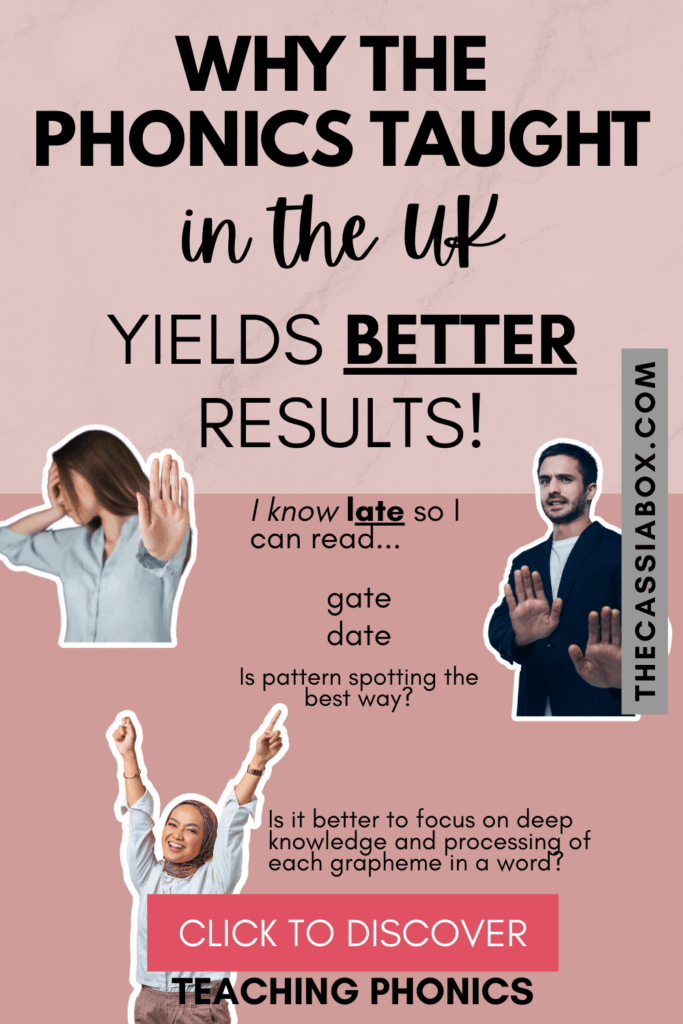
In the synthetic phonics approach, blending is a form of ‘deep processing’. This means that each individual sound (phoneme) in a word is identified and blended to read the whole word. This contrasts with shallow processing strategies, such as using knowledge of onset and rime — for example, reading ‘gate’ and then applying the same pattern to read ‘mate’ or ‘late’.
📌 Need support with this vital skill? Check out How to Teach a Child to Blend – Proven Strategies for step-by-step guidance.
- Children are taught to segment.
In phonics instruction, students are also taught to segment words to spell. Segmenting means split a word into its individual sounds. For example, segmenting hat means saying the sounds h-a-t This consistent approach helps children decode unfamiliar words and builds strong reading confidence.
Phonics Is Not...
Phonics stands apart from other reading methods. Here’s what it’s not:
❌ The Whole Language Approach
This method emphasises learning to read as a process that happens naturally, with the idea that children will recognise whole words through repeated exposure. There’s a strong focus on memorising sight words and using context cues and pictures to decide if a word makes sense in a text.
Phonics, by contrast, explicitly teaches decoding skills using letter-sound knowledge. It equips children to read unfamiliar words, not just recognise familiar ones.
❌ The Three Cueing System
The three-cueing strategy prompts children to draw on three cues when reading:
- Semantic cues (meaning): Does the word make sense?
- Syntactic cues (structure): Does it sound right in the sentence?
- Graphophonic cues (visual): Does it look right?
The first two cues, semantic and syntactic are used first. Critically, the graphophonic cue— looking at the letters or sounding out using phonics—is often used last and considered the least reliable. In contrast, phonics instruction teaches children to prioritise accurate decoding through letters and sounds as the first and most important strategy.
❌ Sight-Word Memorisation Alone
This approach focuses on memorising whole words as visual units, without breaking them down into individual sounds. While phonics programmes do include some high-frequency words learned by sight, the emphasis remains on teaching children how to decode any word—familiar or not—by blending sounds together.
Phonics doesn’t rely on memorisation; it gives children the tools they need to read any word independently and confidently.
Like free stuff? Yes Please👇
FREE PASTEL CALENDAR KIT
Packed with soo many resources – monthly calendar, pocket calendar, special events cards AND more!

Conclusion
Phonics is a tried, tested, and trusted method for teaching children to read. By focusing on the building blocks of language—sounds and letters—it sets children up for success not only in reading but also in writing and spelling.
Phonics works, and particularly synthetic phonics works because the skills a child needs to confidently and independently decode or read a word are taught explicitly. But this is not all! The aim is not be just learn phonics, phonics is the vehicle to becoming a skilled reader. Once word reading skills are mastered and a child can “read most words ‘at a glance’ and can decode unfamiliar words easily, they are free to think about the meaning of what they read. They can then begin to develop their understanding of language through their reading as well as through their listening” (Department for Education, The Reading Framework, UK, 2021).
📚 Don’t Forget to Check out these Phonics Resources
📌 Still have questions about terminology or best practices? Be sure to read:
- 🔟 10 Common Phonics Mistakes and how to avoid them – to sharpen your teaching or home-learning toolkit.
- 🧠 Crack the Code: Understanding Phonics Terms Easily
- 🔤 Can Phonics Help Spelling? Read the blog post to find out how it can!
Life’s Better Together! Sign Up & Stay In the Loop.
Thank you!
You have successfully joined our subscriber list.
Check Out My Other Resources...
Thanks for stopping by. Looking for some classroom printables? Check out these posts:
- ☀️ Seasons and months posters – Support your learns to learn the seasons and which months they are in.
😊 Welcome Signs Pack – Get a set of gorgeous welcoming signs to brighten your room.


